Bringing tire inspection into the age of AI.
Lenovo is incubating edge-AI enabled full surface inspection and X-ray inspection solutions for one of tire manufacturing's most critical quality gates.

Final inspection is mission-critical and still highly dependent on manual work.
For tire manufacturers, the last inspection step is a quality gate before product reaches the customer. In many plants, that process still relies heavily on people visually inspecting every tire, creating an opportunity to improve consistency while reducing repetitive effort.
The challenge is not simply “find a defect.” A production solution needs to see enough of the tire, identify potential issues reliably, fit into plant operations, and support quality teams without creating an unsustainable volume of false positives.
- 01
Manual effort at scaleFinal inspection remains heavily manual in many plants, making automation a meaningful operational opportunity.
- 02
Consistency of judgmentManufacturers need repeatable inspection outcomes across shifts, operators, tire types, and production volumes.
- 03
Production-readinessA useful AI system has to operate continuously and keep false positives low enough for real manufacturing workflows.
- 04
Defects can require more than 2D imagerySome defect criteria depend on depth, making 3D capability important for parts of the inspection problem.
Capture the tire. Detect potential defects. Support the quality decision.
Lenovo’s incubation project combines computer vision and edge-AI to deliver full surface and X-ray inspection solutions designed for the tire manufacturing environment.
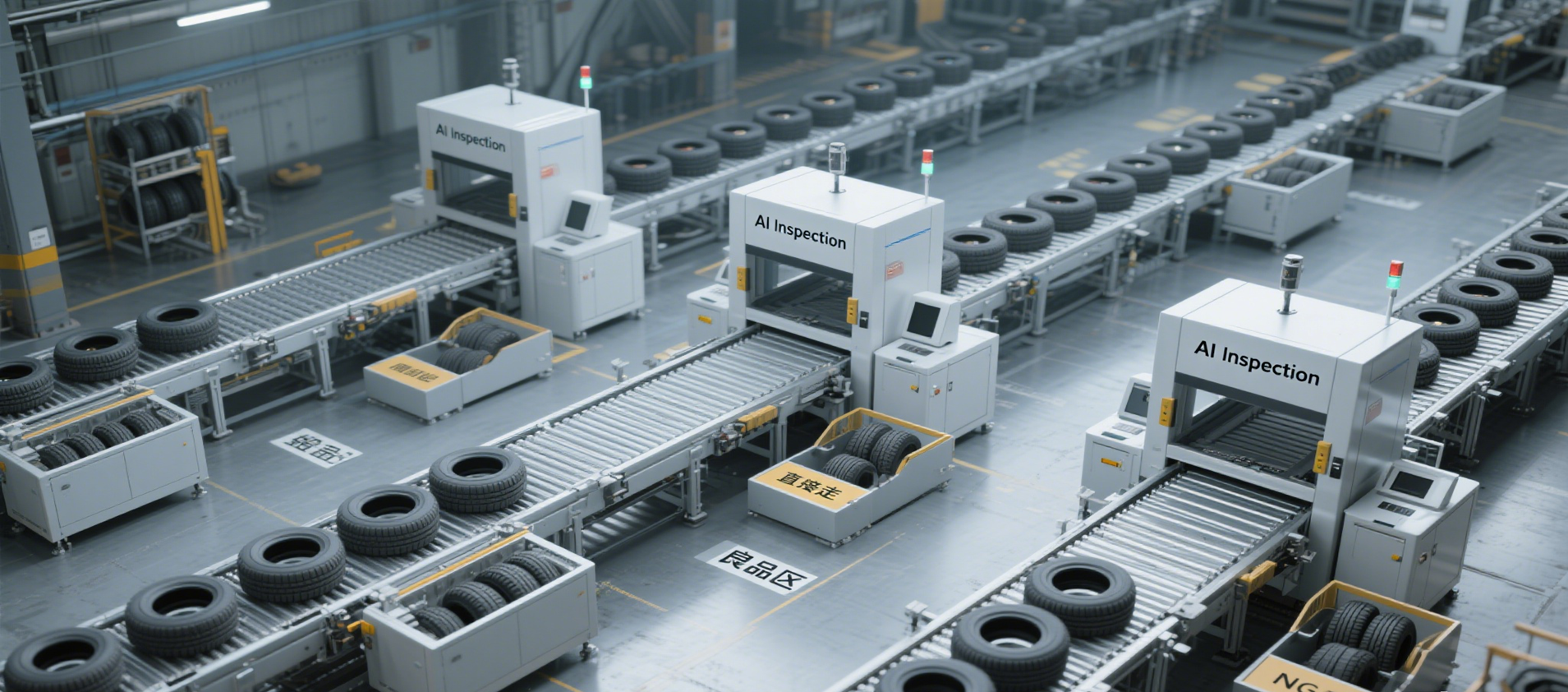
CAPTURE
See what quality teams need to see
Use imaging systems to capture the tire surface and internal views required for inspection. Planned 3D capability extends the system to defect criteria where depth matters.
DETECT
Identify defect candidates with AI
Run computer-vision models at the edge to identify anomalies and potential manufacturing defects while the product is still in the plant.
DECIDE
Turn detections into a quality workflow
Surface findings to the inspection process so quality teams can make the final decision and use the results to improve operations over time.
Full Surface Inspection + X-ray inspection, with algorithm improvement, continuous-operation stability, and 3D inspection among the current maturation priorities.
Differentiate on the inspection challenge that really matters, not AI just for AI’s sake.
Broad inspection scope
The incubation spans AI-enabled Full Surface Inspection and X-ray inspection, addressing multiple parts of final tire quality inspection.
Edge-AI deployment
Inference is designed around the manufacturing environment, bringing AI inspection close to the production process rather than treating inspection as a cloud-only workflow.
Depth-aware inspection
3D inspection is being developed for defect criteria where depth cannot be reliably judged from 2D imagery alone.
Lower false-positive burden
The next algorithm iteration is explicitly focused on materially reducing false positives and shortening the data/iteration cycle required to reach production performance.
Answer the question a customer will eventually ask: “Why should Lenovo be the company that solves this?”
The current project portfolio deck does not yet contain enough substantiated Lenovo-specific proof points to make this section externally defensible. Rather than invent them, the design reserves the exact evidence that should go here.

[Lenovo technology advantage]
PLACEHOLDER — Identify the Lenovo-owned technology, IP, edge platform, AI tooling, or system architecture that materially improves the solution.
[Industrial deployment advantage]
PLACEHOLDER — Add evidence of Lenovo's ability to integrate, deploy, support, and operate this solution in manufacturing environments at scale.
[Commercial / ecosystem advantage]
PLACEHOLDER — Add the Lenovo customer reach, partner ecosystem, manufacturing relationships, service model, or business ownership that a specialist AI vendor cannot easily replicate.
Customer-led incubation
The project is already being shaped through real tire-manufacturer acceptance work and demonstrations, keeping product maturation tied to deployment requirements rather than only technical research.
Move from promising solution to repeatable product.
Algorithm performance
Reduce false positives and shorten the iteration cycle needed to reach target performance.
Continuous-operation stability
Demonstrate reliable operation over the sustained production conditions required by factories.
3D inspection
Add depth information for defect classes whose acceptance criteria cannot be determined from 2D imagery alone.
Repeatable deployment
Turn customer-specific pilots into a product and deployment model that can scale to additional plants and manufacturers.